
les misérables and love
story shapes life

I have been thinking a lot about the story of Les Misérables lately. If you are not familiar, Les Misérables (often shortened to Les Mis) is a novel written by Victor Hugo in 1862. It is a tale of redemption, faith, sacrifice and romance, set in post-Revolution France. It has been adapted into one of the most beloved Broadway musicals of all time, as well as multiple film and television adaptations.
I was first introduced to Les Misérables around the age of eleven through the Focus on the Family Radio Theater version of it, which is brilliant. As a homeschooled kid whose mother heavily limited television (thank you, Mom!), radio dramas were just the best.
Soon after that, my Dad showed us Susan Boyle’s rendition of “I Dreamed A Dream,” as well as the 25th anniversary cast performing “One Day More.” Was it just the fact that Nick Jonas sang a short solo that made me watch it on repeat? Possibly. Ironically, watching it now, it is very clear that Jonas is the worst singer of the bunch. Haha.
My next Les Mis immersion happened in 2012, when the musical was made into a movie. We watched an edited version that excluded two explicit scenes, but that did not matter to me. The next fifteen years of my life have consisted of lip-syncing, singing, acting out, and even performing versions of the soundtrack. My younger sister and I went through a phase of being deeply obsessed with Aaron Tveit, who played the character Enjolras. I am not lying when I say I could sing the full three hours, beginning to end.
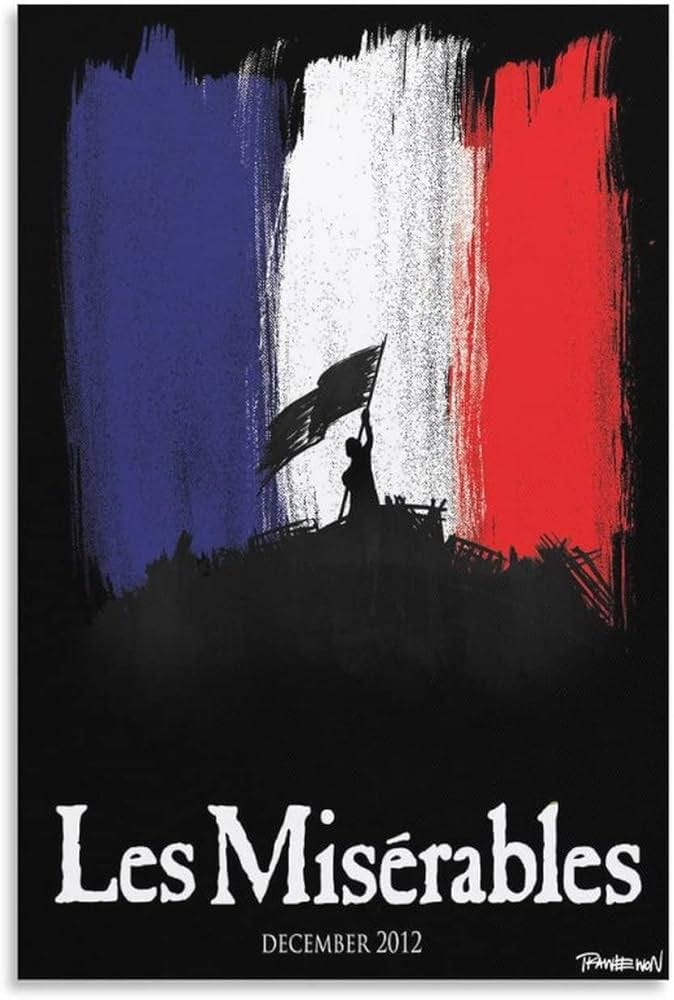
This deep love of the musical prompted me to read the original novel, which is around fifteen hundred pages. Well worth it, though. There is so much background and depth given to the characters that is impossible in a film or audio adaptation.
As a young adult, I attended a small Catholic college that, to my great joy, was filled with nerds like me. A group of us decided to perform “One Day More” costumes and all at an in-house kitchen party. I played Cosette. The young man I had started to develop feelings for played Marius, her love interest. It was romantic, and has become even more so now that that man is my husband. There is a recording of this performance, but I shall keep that from the rages of the internet.
At the same college, we also had to write a reflection paper on Les Miserable, in light of the Theology of the Body by St. John Paul II. More on that later.
A few years ago, my husband and I discovered that the Les Misérables musical was originally written in French. My husband, whose first language is French, began to play it around our home. It brings a whole new level of emotion to listen to it in the original language. The translation to English is not word-for-word, not even close. I have enjoyed hearing how the French version holds onto poetry, where the English opted for having a good hook.1
Perhaps the way that Les Mis has most clearly become intertwined with my life happened on a cold February night, shortly after I learned I was pregnant with our second child. The name Marius popped into my head with no prompting. Once it was there, I inexplicably knew that would be the name for our baby, even though I did not yet know it was a boy. And now we have had a little Marius crawling around our home for almost a year. It brings me a great sense of kindred spiritship when people recognize the name from Les Mis. Interestingly, after we chose the name, we learned that there is a St. Marius and that my husband had a great, great uncle named Marius.
Why has this story been on my mind lately? My husband and I just purchased tickets to see the touring Broadway version of Les Mis, which is coming to us in early 2026. In anticipation, I have been listening to the soundtrack and reflecting on how stories influence and shape our lives.
There are so many themes in the story of Les Mis, but a few stand out to me.
The first of these is the battle between the Gospel and the Law.
The criminal Jean Valjean, faces condemnation on all sides, until he is met by grace in the form of a Catholic bishop. This encounter leads him to change his life. He sees his sin, and leaves the old man behind. A new story begins.
“I am reaching, but I fall
And the night is closing in
As I stare into the void
To the whirlpool of my sin
I’ll escape now from that world
From the world of Jean Valjean
Jean Valjean is nothing now
Another story must begin.”2
He embraces a new name, and builds a life for himself.
Yet, one man cannot accept this. As much as Valjean embraces redemption and grace, the police inspector Javert does not. He believes only in the law, which says the guilty must be punished. He is relentlessly in seeking out Valjean, in order to return him to prison.
“And so it has been, and so it is written
On the doorway to paradise
That those who falter and those who fall
Must pay the price!”3
Ultimately, when grace and law face each other, grace wins. When the law meets radical forgiveness, Javert’s world caves in and he despairs. But Valjean’s acceptance of grace leads him to the light of heaven.
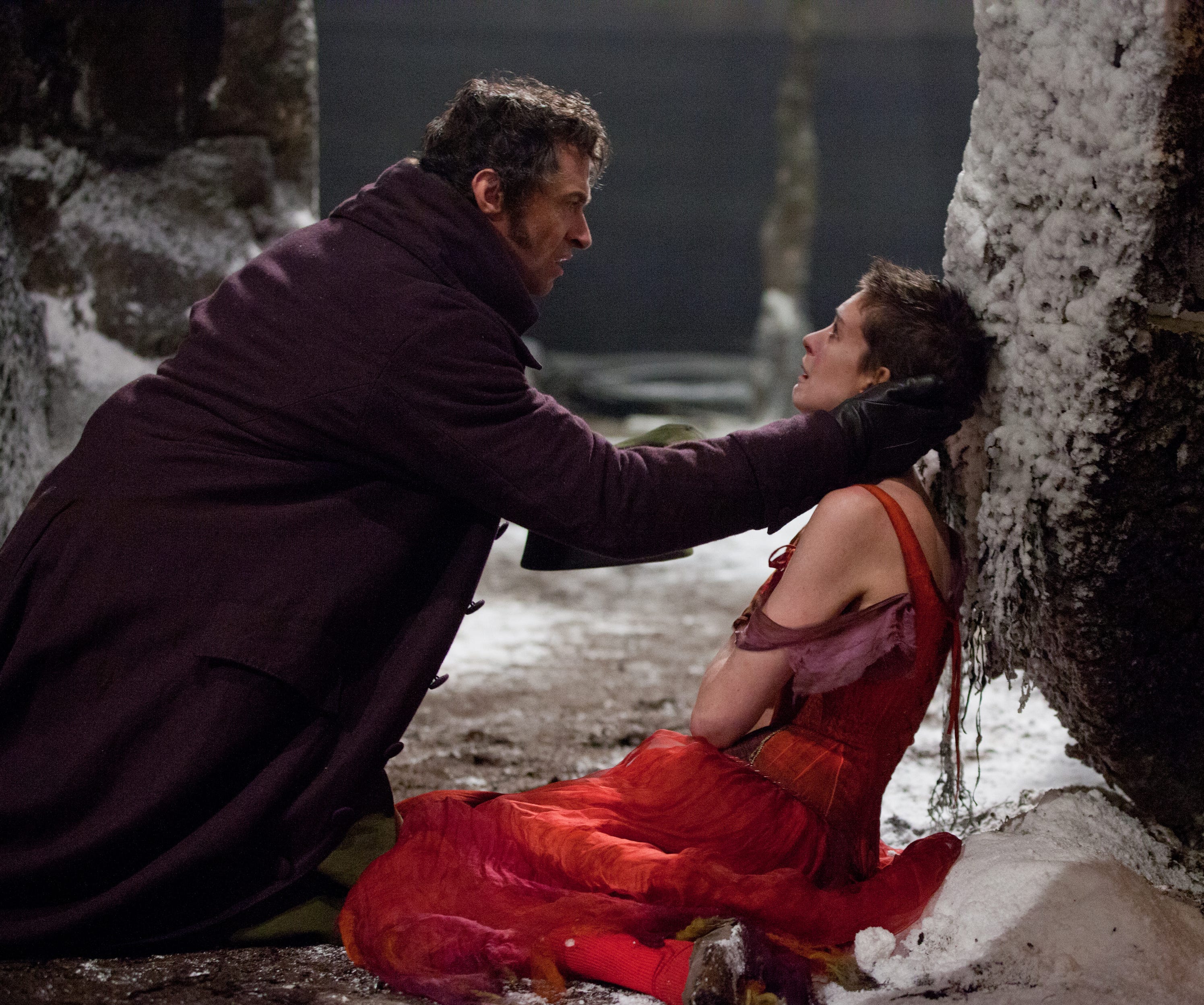
Another theme of the story is that of the struggle and beauty of bodies, of the flesh. The character of Fantine is rejected, objectified, and later dies because of actions of the flesh— namely, the “unholy” circumstances that led her to give birth outside of wedlock. She is forced into prostitution, ruined forever in the eyes of society. It is only Valjean who still sees the goodness of her body and its beauty, despite how it has been treated. The brokenness of her body illustrates the brokenness of her soul. “Where will she end -
This child without a friend?”4
This brings me to Theology of the Body:
“The body, in fact, and only the body, is capable of making visible what is invisible: the spiritual and the divine. It has been created to transfer into the visible reality of the world, the mystery hidden from eternity in God, and thus to be a sign of it.” (TOB 19:4).
The body is an icon, an image, that point us to God. Too often, we judge people based on their outward presentation. If their appearance displeases us, we make an assumption about what they are on the inside. If we see someone dressing in a promiscuous way, with ugly tattoos or acting in a way that is not in line with their biological sex, we are quick to condemn. But Valjean reminds us that the body shows the soul. If the body is displaying disorder, our first reaction should be mercy and grace. It is illustrating a point of struggle and suffering in their soul.
Another part of the story that points to the power of the body to point us to heavenly mysteries is that of the love story between Marius and Cosette. They pass each other in the street, and the next thing you know, they are singing to each other: Marius: “A heart full of love”, Cosette: “A heart full of you, This is a chain we’ll never break.”5 It is love at first sight, taken to the extreme. It may seem silly at first, but I think their story is a deep testament to how beauty can move our souls. Marius sees Cosette and his world is forever changed. He tells his dubious friends:
“Had you been there tonight
You might know how it feels
To be struck to the bone
In a moment of breathless delight!
Had you been there tonight
You might also have known
How the world may be changed
In just one burst of light!”6
Beauty has that power. And even though it can make us uncomfortable to admit, the beauty of the body should fill us with awe and wonder. After all, it shows us something of the beauty of God. Before becoming Pope Benedict, Cardinal Ratzinger wrote that “The encounter with the beautiful can become the wound of the arrow that strikes the heart and in this way opens our eyes.” 7Marius and Cosette open themselves wide to beauty, and to love— and their lives are forever changed. Even in the midst of a bloody revolution, with death grasping at theirs heels, they allow beauty to pierce them.
One of the final lines in the musical of “Les Misérables” is this: “To love another person is to see the face of God.”8 All the characters join together in a chorus that celebrates the truth of beauty, the truth of life. Even though we experience deep brokenness in our bodies, sinfulness, and pain, that is no match for the glory of God that is man fully alive. 9

In closing, deeply human stories have so much to offer us. As I have experienced with Les Mis, the truths that they carry can shape our minds and lead us to see the world with new eyes. Les Misérables reminds me that even amidst suffering and seeming failure, our lives have meaning and purpose. Every time we embrace beauty, or extend grace to a suffering person,10 we are making God visible.
Things I’ve Enjoyed Lately
If you haven’t checked out Haley Baumeister’s compilation on the body, please do! There is something for everyone there; “an ongoing education in embodiment through physiology, sociology, and theology/ethics/moral and spiritual depths.”

I turned to it once again after reading Abigail Favale recent article on Rethinking Complementarity.
This simple and delicious recipe for chocolate that is healthy. To note, you can use any nut butter and i is much, much better if you use maple syrup instead of stevia.
Two podcast episodes that made be feel deeply seen as a parent of toddlers, as well as this article by Katie Noble.
A fun (and clean) show called A Man on the Inside.

Peace,
Hannah Chartier
For example, here is part of On My Own in the English adaptation, versus L’un Vers L’Autre (original French, translated):
On My Own:
And now I’m all alone again
Nowhere to turn, no one to go to.
Without a home, without a friend
without a face to say hello to
But now the night is near
And I can make-believe he’s here
Sometimes I walk alone at night
When everybody else is sleeping
I think of him and then I’m happy
With the company I’m keeping
The city goes to bed
And I can live inside my head
L’un Vers L’Autre
Two angels who discover each other
Have nothing to explain.
Two souls who find each other again
Have said everything without speaking.
I often dreamed in Marius’ arms to be in her place.
Before this happiness from another world,
Jealousy disappears
They walked without knowing one after the other
Like luck when she looks for the chance.
Two children put into the world one for the other
In order to play the leads in a story.
Beautiful, isn’t it?
from “Soliloquy”
from “Stars”
from “Fantine’s Arrest”
from “A Heart Full of Love”
from “ABC Cafe”
in “The Feeling of Things, the Contemplation of Beauty”
from “Finale”
St. Irenaeus
interesting how the France flag colors (featured prominently in the story) are the same as those in the Divine Mercy image
I recall being moved to tears as I read all the indignities that Fantine suffered in Les Miserables. I was also struck by the mercy and grace shown to Jean Valjean by Bishop Myriel, contrasted with the relentless hounding by Javert. In fact, I have a strong inner critic, and I have decided to name him after Inspector Javert because he is an enemy of mercy and grace and of the belief that someone could change. The novel, the music, various versions of the movies and the musical will forever touch my soul as few other things do, primarily because of the mercy and grace shown being so instrumental in Valjean's conversion.
Also, I have to share that in listening to Relevant Radio, I learned that the real-life bishop (Bishop Bienvenu de Miollis, Bishop of Digne from 1805-1838) is who Bishop Myriel in Les Miserables was patterned after, and his cause is up for beatification!
We've also used the name Cosette as one of our daughter's middle names.
Love this article! God bless you and yours.
I love this story, too! It has inspired me in so many ways, especially when it comes to the mercy and grace of God. I also loved it that the happy ending of the story was something that all of us can look forward to. It teaches us that no matter how much of a failure one's life could appear to be on earth, it can still be redeemed and we can all find happiness one day if we can only have faith, hope and love.
O, how we all need the mercy and grace of God! May we help others see His face also in us as we shine forth with love for our fellowmen.
“Forget not, never forget that you have promised me to use this silver to become an honest man.... Jean Valjean, my brother: you belong no longer to evil, but to good. It is your soul that I am buying for you. I withdraw it from dark thoughts and from the spirit of perdition, and I give it to God!” - Victor Hugo, Les Misérables